
Home »
Automated Valve Control Systems Review
Table of Contents
- What Automated Valve Control Systems Do
- Pneumatic vs Electric Valve Actuators: Which Fits Your Application
- Valve Actuator Sizing: Getting the Spec Right
- Actuated Valve vs Control Valve: Understanding the Difference
- Automated Valve Packages for Industrial Operations
- Cost-Benefit Analysis: When Automation Pays Off
- Reliability, Maintenance, and Support
- Conclusion
- Frequently Asked Questions
Last Updated: October 9, 2026
What Automated Valve Control Systems Do
Automated valve control systems combine control valves, actuators, and instrumentation to regulate fluid flow without manual intervention, holding setpoints for pressure, temperature, or flow in real time.
At Valtorc International, we’ve engineered automated valve packages that handle everything from simple on-off switching to precise modulating control across oil and gas, chemical processing, water treatment, and food and beverage applications. The market for these systems continues to expand, the global valve remote control systems market is forecast at USD 9.5 billion in 2026, with a projected 6.7% CAGR through 2036, reaching USD 18.1 billion Future Market Insights Valve Remote Control Systems Market.
What separates a working system from a failing one is precision in three areas: valve selection, actuator sizing, and control logic tuning. Get any wrong and you waste energy, miss setpoints, or create safety hazards.
The most common mistake is oversizing the actuator. A larger actuator responds slower and consumes more air or electricity. Match actuator force to actual load requirements, not worst-case scenarios.
Pneumatic vs Electric Valve Actuators: Which Fits Your Application
Pneumatic and electric actuators dominate industrial automation but solve different problems; the choice depends on environment, response speed, and cost.
Pneumatic actuators use compressed air to move the valve stem.
Electric actuators use a motor to drive the valve.
Petrochemical plants with existing compressed air and Class I Division 1 locations favor pneumatic. Food and beverage facilities needing FDA compliance and remote monitoring favor electric.
According to 360iResearch Automatic Water Control Valves Market, the automatic water control valves market reached USD 5.17 billion in 2025 and is expected to grow to USD 5.53 billion in 2026, reflecting strong adoption of electric automation in municipal and industrial water systems.
Pneumatic excels in safety-critical and remote applications. Electric dominates where precision and integration matter more than upfront cost.
Valve Actuator Sizing: Getting the Spec Right
Actuator sizing is where most projects derail: engineers oversize for safety margin or undersize to save cost, and both backfire.
Too many teams skip the calculation and order a “medium” or “large” actuator. An oversized pneumatic actuator responds sluggishly; an oversized electric actuator wastes power and can overstroke the valve, damaging the seat; an undersized actuator stalls under load, causing process upsets or safety failures.
The right method: get the valve’s technical data sheet, identify maximum cracking pressure and flow conditions, run the force calculation, and match the actuator to it.
For modulating control (not just on-off), actuator response time also matters. A 5-second stroke time is appropriate for most industrial applications.
Actuated Valve vs Control Valve: Understanding the Difference
These terms are often used interchangeably but describe different designs.
A control valve is a valve body designed for throttling, with a shaped plug and seat for precise flow modulation.
An actuated valve is any valve with an actuator attached, such as a ball, gate, or butterfly valve with an electric or pneumatic actuator bolted on.
The distinction matters for selection. A reactor requiring ±2% temperature control needs a control valve with an electric actuator and feedback loop; a water distribution network switching supply lines is served cheaper and faster by an actuated ball valve.
Research from P. Cană et al. Review of Safety Valves Standards Design and Applications shows that proper valve selection based on application requirements is critical for system reliability and safety performance.
Installing an actuated gate valve where a control valve is needed will cause hunting (constant oscillation around setpoint) and premature wear. The valve body simply isn’t designed for modulation.
Automated Valve Packages for Industrial Operations
An automated valve package bundles the valve, actuator, positioner, and instrumentation into a tested assembly ready for installation, cutting engineering time, reducing field integration errors, and ensuring components work together.
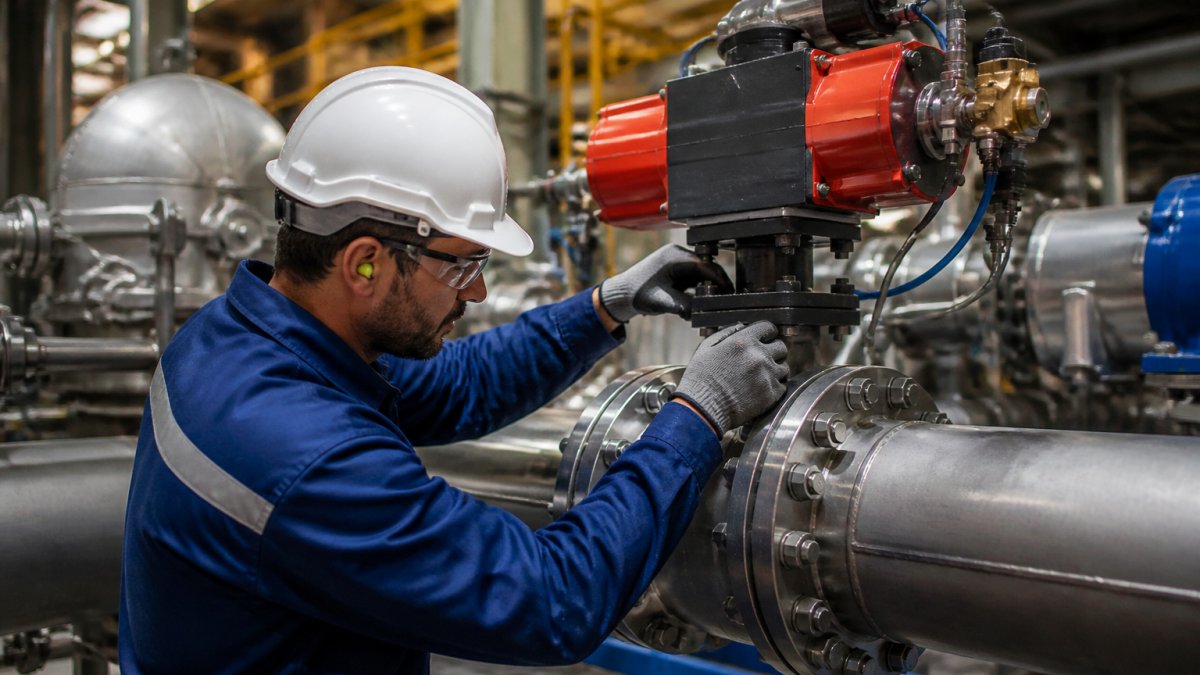
Industrial operations benefit most from pre-engineered packages. A petrochemical plant building a distillation unit can’t source a valve here, an actuator there, and a positioner elsewhere.
The cost advantage is real: a complete package costs less than separate components, lead times are faster because everything is pre-tested, and one manufacturer stands behind the whole system.
Cost-Benefit Analysis: When Automation Pays Off
Automation is not always the answer. Manual valves are cheaper upfront and need no power or instrumentation; the question is whether labor savings, energy, maintenance, and avoided downtime justify the investment over the asset’s life. A total cost of ownership (TCO) view beats purchase price alone.
The five cost buckets in a TCO model
- Purchase price, valve body, actuator, positioner, solenoid, limit switches, and mounting hardware. A pre-engineered package usually costs less than sourcing components separately.
- Installation, wiring or air-line runs, mounting, calibration, and commissioning labor. Pneumatic installs cost less electrically but need compressor capacity and air treatment; electric installs avoid air infrastructure but need power and, in hazardous areas, certified enclosures.
- Energy, compressed air is one of the most expensive plant utilities, so pneumatic actuators carry an ongoing cost that’s easy to overlook. Electric actuators draw power only when stroking, favoring them in low-cycle or modulating duty.
- Maintenance, air filters, regulators, and moisture traps on pneumatic systems; motor bearings, lubrication, and electrical connections on electric; positioner and solenoid replacement on both.
- Downtime and labor, the cost of an unplanned failure and the labor hours removed from manual valve adjustment.
A worked example with stated assumptions
The numbers below are illustrative, not quoted prices. Substitute your own site data.
That payback works for most industrial projects with a 10+ year asset life, but labor alone rarely tells the whole story. Add energy, maintenance, and downtime:
- Energy: a frequently cycling pneumatic actuator can consume a meaningful share of compressed-air capacity. If your compressor is near its limit, the true cost includes compressor capacity, not just air.
- Maintenance: positioners and solenoids are the most frequent failure points on either technology. Budget for periodic replacement, not lifetime components.
- Downtime: a breakdown lasting 8 hours instead of 2 days can save tens of thousands in lost production, often dwarfing labor savings.
Where automation pays back fastest
The strongest business cases share a pattern: automation improves quality or reduces waste, not just labor.
- A chemical plant holding temperature within ±1°C instead of ±5°C using automated control may reduce off-spec batches, recovering product that would otherwise be reworked or scrapped.
- A water treatment plant automating filter backwash sequences reduces water waste and chemical consumption.
- A food and beverage plant automating CIP sequencing cuts cleaning time and water use between runs.
These benefits often exceed direct labor savings, so build the payback case on quality and waste first, labor second.
When manual still wins
Automation is hard to justify when a valve is adjusted rarely, sits in a non-hazardous location, and has no quality or safety impact; a manual isolation valve on a low-cycle line may never repay an actuator.
The global industrial valves and actuators market is projected to grow from USD 170.64 billion in 2026 to USD 261.64 billion by 2034 Fortune Business Insights Industrial Valves and Actuators Market, reflecting strong demand for automation in cost-sensitive industries.
Build the business case on total cost of ownership, not purchase price. Labor savings alone often produce a 2.5- to 4-year payback; quality, waste reduction, and avoided downtime are what usually make automation clearly worthwhile.
Reliability, Maintenance, and Support
Automated systems are only as reliable as their weakest component. A quality valve body can last 20+ years; an actuator typically lasts 5-10 years depending on duty cycle; positioners and solenoid valves fail most often. The sections below turn that into an ownership plan: what fails, how to detect it, how often to service it, and what to keep on the shelf.
Failure modes by component
| Component | Common failure mode | Early warning sign | Typical service interval |
|---|---|---|---|
| Valve body / seat | Erosion, seat wear, leakage past the seat | Rising actuator travel for the same flow; audible passing | Inspect annually; rebuild on leakage |
| Pneumatic actuator | Seal and diaphragm wear, moisture contamination | Slower stroke, air leaks, erratic position | Inspect seals annually; rebuild per duty cycle |
| Electric actuator | Bearing wear, lubrication breakdown, electrical connection corrosion | Increased motor current, slower stroke, heat | Lubricate and inspect annually |
| Positioner | Stiction, calibration drift, clogged air ports | Hunting around setpoint, offset from command | Calibrate annually; clean air ports |
| Solenoid valve | Coil failure, contamination, seal wear | Failure to shift, intermittent operation | Inspect annually; replace on fault |
Stiction, static friction that prevents smooth valve motion, commonly causes poor modulating performance, showing up as the valve sticking then jumping past the setpoint. It’s usually a positioner or packing issue, not a valve body issue.
Preventive maintenance that actually extends life
- Pneumatic systems: service air filters, regulators, and moisture traps on a fixed schedule. Moisture and oil carryover lead to premature pneumatic actuator failure.
- Electric systems: lubricate motor bearings and inspect electrical connections for corrosion and tightness. Heat and loose connections shorten motor life.
- Control valves: inspect the spool and seat annually for erosion or stiction, especially in dirty or high-cycle service.
Diagnostics and condition monitoring
Modern positioners and smart actuators report valve travel, cycle count, and deviation from command. Trend that data instead of waiting for failure:
- A rising cycle count with a stable process indicates normal wear.
- Increasing actuator travel for the same flow suggests seat wear or leakage.
- Growing deviation between command and actual position points to stiction, calibration drift, or a failing actuator.
Set a deviation threshold that triggers inspection before the valve affects the process, converting unplanned failure into scheduled repair.
Spare-parts strategy
Downtime usually comes from waiting for a part, not the failure itself. Keep on hand:
- Positioners and solenoid valves, the most frequent failure points.
- Actuator seal and diaphragm kits matched to your models.
- Valve seat and packing kits for high-cycle or erosive service.
Match spares to each loop’s criticality: a valve on a continuous process line justifies more inventory than an isolation valve cycling a few times a year.
Documentation and support
Documentation is underrated. Every automated valve package should include P&ID diagrams, calibration records, spare-parts lists, and troubleshooting guides; too many installations lack this, leaving maintenance teams guessing when problems arise.
When failures occur, response time matters. Valtorc International offers 24/7 support and same-day shipping on stock items, critical for continuous-process plants where a breakdown lasting 8 hours instead of 2 days can save tens of thousands in lost production.
Skipping annual positioner calibration is one of the most common causes of poor modulating control. A drifting positioner looks like a valve problem but is usually a calibration problem.
Conclusion
Choosing the right automated valve control system means matching valve type, actuator technology, and package design to your process conditions. Pneumatic and electric actuators serve different environments. Sizing must be precise.
Valtorc International delivers custom-engineered automated valve packages backed by 40+ years of industrial experience, direct-from-manufacturer pricing, and 24/7 support. We handle the engineering complexity so your operations run reliably.
Frequently Asked Questions
What is the main difference between an actuated valve and a control valve?
An actuated valve uses an external device (actuator) to open or close the valve automatically, while a control valve modulates flow internally through a valve plug and seat. Actuated valves are typically on-off devices controlled by external signals, whereas control valves adjust flow continuously. Both can be part of an automated valve control system, but they serve different functions: actuated valves handle switching, and control valves handle precise flow regulation.
How do you determine the correct size for a valve actuator?
Actuator sizing depends on the valve’s torque or force requirements, which are determined by the differential pressure across the valve, the valve’s size, and the material being controlled. You must calculate the operating torque needed to move the valve stem against system pressure, then select an actuator with sufficient output capacity plus a safety margin. Undersized actuators fail to open or close the valve reliably; oversized actuators waste energy and cost more. Most manufacturers provide sizing charts or calculators to match actuator output to your specific valve and application.
When is investing in automated valve control systems worth the cost?
Automation typically pays off when manual operation is frequent, labor costs are high, precision control is critical, or safety requires remote operation. Industries like oil and gas refining, water treatment, and chemical processing benefit because operators avoid hazardous environments and valve response times improve. The break-even point depends on how often the valve operates and your labor costs. For applications requiring only occasional manual adjustments, the investment may not justify the expense. A cost-benefit analysis comparing installation costs against labor savings and uptime improvements helps determine ROI.
What maintenance do automated valves and actuators require?
Automated valve systems require regular inspection of the actuator for seal wear, lubrication of moving parts, and testing of control signals. Pneumatic actuators need clean, dry air supply and filter maintenance. Electric actuators require checking electrical connections and ensuring proper voltage. Hydraulic systems need fluid condition monitoring. Preventive maintenance schedules vary by actuator type and operating environment but typically include annual inspections, functional testing, and replacement of wear items. Proper maintenance extends system life and reduces unexpected failures.

CREDIT APPLICATION
Please fill out our credit application for purchase orders and net terms. Download here

DISTRIBUTORS WANTED
Apply to become an official protected distributor. Click here to fill out our distributor application. (Online Form)

VALVE PRODUCT CATALOG
New! Download our 2018 product overview catalog or call us to request a copy. Click here to download (PDF)


