
Home »
Valve Actuator Guide: Sizing, Types & Maintenance
Table of Contents
- What a Valve Actuator Does and Why It Matters
- Valve Actuator Types: Electric, Pneumatic, Hydraulic, and Manual
- Pneumatic vs Electric Valve Actuators: Which Fits Your Process?
- Valve Actuator Sizing Calculation: A Step-by-Step Guide
- Environmental and Hazardous Area Certifications
- Valve Actuator Maintenance Best Practices
- IIoT and Smart Factory Integration
- Conclusion
- Frequently Asked Questions
Last Updated: October 1, 2026
What a Valve Actuator Does and Why It Matters
A valve actuator opens and closes a valve automatically, replacing manual handwheel turning with controlled mechanical power. Valtorc International has spent over 40 years building automated valve packages for refineries, chemical plants, and water treatment facilities.
- Automation removes the need for manual labor at each valve
- Process control keeps flow, pressure, and temperature inside limits
- Safety lets a valve close on its own when power or air is lost
- Speed cuts actuation time from minutes to seconds
The actuator, not the valve body, usually determines whether an automated package meets your process requirements.
Valve Actuator Types: Electric, Pneumatic, Hydraulic, and Manual
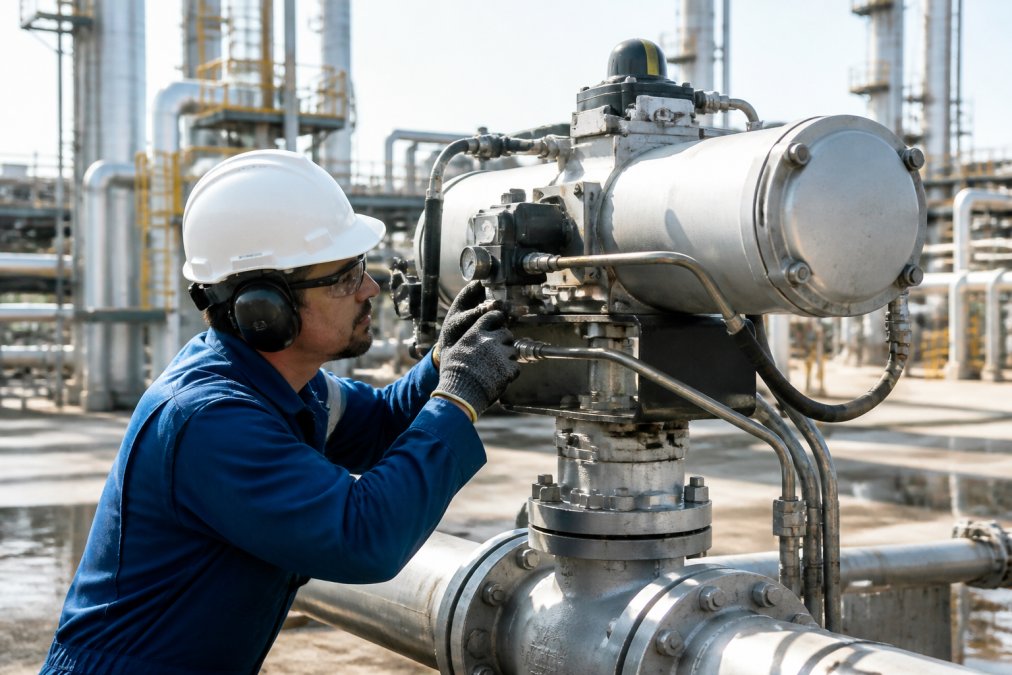
Four actuator types cover nearly every industrial job: electric, pneumatic, hydraulic, and manual. Each trades off power source, speed, torque, and cost.
How Each Actuator Type Works
Electric valve actuators use a motor and gearbox to drive the valve stem. A control signal, often 4-20mA, tells the motor how far to turn. Limit switches stop travel at each end.
Pros and Cons at a Glance
| Type | Power Source | Best For | Main Drawback |
|---|---|---|---|
| Electric | Motor, 4-20mA signal | Remote sites, modulating control | Slower on large valves |
| Pneumatic | Compressed air | Fast on-off, fail-safe duty | Needs clean, dry air supply |
| Hydraulic | Pressurized oil | High torque, big valves | Leaks and fluid upkeep |
| Manual | Human effort | Bypass, backup, low duty | No automation or speed |
Pneumatic vs Electric Valve Actuators: Which Fits Your Process?
Pneumatic actuators win on speed, cost, and fail-safe behavior; electric actuators win on remote operation and precise modulating control. The right pick depends on your air supply, power supply, and duty cycle.
A few practical rules:
- No plant air? Go electric.
- Need fail-safe on air loss? Spring return pneumatic is the standard answer.
- High duty cycle with constant modulation? Electric with a positioner holds up well.
- Explosive atmosphere? Both types can qualify, but check the enclosure rating first.
Valve Actuator Sizing Calculation: A Step-by-Step Guide
Sizing is where most actuator projects succeed or fail, and it is the step most guides skip. A valve actuator sizing calculation matches the actuator’s rated output torque to the torque your valve demands, plus a margin for friction, pressure, and time between cycles. Undersize it and the valve stalls mid-stroke; oversize it and you pay more and can damage the stem or seat.
The Torque Components You Must Add Up
Actuator sizing sums several torque demands, each peaking at a different point in the stroke:
- Break torque (breakaway torque), the torque needed to unseat the closure member from its seated position, almost always the highest number you will see.
- Run torque, the torque needed to keep the closure moving once it has broken free. Typically lower than break torque, but it rises with flow-induced dynamic forces.
- Seating torque, the torque required to fully seat the closure at the end of travel so the valve seals. Metal-seated valves need more than soft-seated ones.
- Bearing and packing friction, stem friction from packing glands and bearings, which grows as packing ages and temperature swings.
- Unbalance torque, torque from differential pressure acting on an unbalanced plug or disc; balanced designs reduce it, but rarely to zero.
A Simplified Sizing Formula
A practical working relationship looks like this:
Required actuator torque = (Break torque + Run torque contribution + Seating torque) × Safety factor
- 1.25 to 1.5 for clean, low-cycle, well-lubricated service
- 1.5 to 2.0 for slurry, dry gas, high temperature, or infrequent cycling
- Higher margins for valves that sit in one position for months, because stem friction rises with time at rest
A Worked Example
Suppose a 6-inch metal-seated butterfly valve has a published break torque of 900 in-lb and a seating requirement of 400 in-lb in clean water service; run torque does not govern here.
- Base torque: 900 in-lb (break) governs over run torque.
- Add seating margin: 900 + 400 = 1,300 in-lb.
- Apply a 1.5 safety factor for a moderately cycled line: 1,300 × 1.5 = 1,950 in-lb required.
- Select an actuator whose rated torque at your minimum supply pressure is at least 1,950 in-lb, not its peak rating at ideal pressure.
Sizing Checks Most People Forget
- Verify torque at minimum supply pressure, not nominal, air systems sag and power systems brown out.
- Confirm stroke matches valve rotation, 90° for quarter-turn, many turns for multi-turn, linear for diaphragm and gate valves.
- Check the fail-safe direction. A spring-return spring needs enough stored energy to drive the valve to its safe position against the same torque demands.
- Account for temperature. High process temperature raises packing friction and can derate the actuator.
- Match the mounting interface. ISO 5211 pads and stem couplings must line up, or torque never reaches the valve.
Sizing on run torque alone is the single most common mistake. Break torque can be two to three times higher, and an undersized actuator will stall the valve open or closed, often at the worst possible moment.
Keep the sizing calculation on file with the valve tag number. When the process changes, higher pressure, different media, longer idle periods, you can re-check the margin instead of guessing why the actuator started stalling.
Environmental and Hazardous Area Certifications
Enclosure ratings and hazardous location certifications decide whether an actuator survives your site, and whether it is legal to install there. Buyers skip this part, and it causes failures, shutdowns, and failed inspections.
Enclosure Ratings: NEMA Types and IP Codes
Two rating systems cover how well an actuator housing keeps out dust, water, and corrosion. They overlap but are not identical, and a product may carry one, the other, or both.
NEMA 1, indoor, general purpose, protects against contact with internal parts. Not for dust or water.
NEMA 4, indoor or outdoor, protects against windblown dust and rain, splashing water, and hose-directed water.
NEMA 4X, same as Type 4 plus corrosion resistance. This is the common choice for chemical plants, coastal sites, and washdown areas.
NEMA 6, protects against temporary submersion.
NEMA 7, for indoor hazardous locations with flammable gases or vapors, Class I, Division 1.
NEMA 9, for indoor hazardous locations with combustible dust, Class II, Division 1.
IP66, dust-tight and protected against powerful water jets.
IP67, dust-tight and protected against temporary immersion (typically up to about 1 meter for 30 minutes).
IP68, dust-tight and protected against continuous immersion, at a depth and duration the manufacturer specifies.
Hazardous Location Classification
The National Electrical Code standards published by the National Fire Protection Association set the framework most sites follow. The NEC classifies hazardous areas by class (what is present), division (how often), and group (the specific material), plus a temperature class (the hottest surface the equipment may reach).
- Class I, flammable gases or vapors (for example, refinery process areas).
- Class II, combustible dust (for example, grain handling or some chemical processes).
- Class III, ignitable fibers or flyings.
- Division 1, the hazard is present under normal operating conditions.
- Division 2, the hazard is present only under abnormal conditions, such as a leak or failure.
- Groups, letters A through G identify the specific gas, vapor, or dust. Group B (hydrogen) and Group C (ethylene) are common in process plants; Group D covers many common solvents.
- Temperature class (T1-T6), the maximum surface temperature the equipment can reach. T6 is the most restrictive (lowest surface temperature).
Corrosion and Environmental Exposure
Beyond enclosure and hazard ratings, consider the environment:
- Coastal and offshore sites need corrosion-resistant housings and hardware, often NEMA 4X with stainless or epoxy-coated exteriors.
- Washdown areas in food, beverage, and pharmaceutical plants need ratings that tolerate frequent cleaning and caustic or acidic wash solutions.
- High-temperature process areas require actuators whose internal components and seals are rated for the ambient and radiant heat they will actually see.
- Outdoor installations need UV-resistant housings and heaters or breathers to manage condensation inside the enclosure.
A Pre-Purchase Checklist
Before you buy, confirm the following against the nameplate and datasheet:
- The enclosure rating (NEMA Type and/or IP code) matches your washdown, weather, or submersion exposure.
- The hazardous location certification matches your area’s class, division, and group.
- The temperature class is at or below the maximum surface temperature your area allows.
- The materials of construction resist the specific chemicals and cleaning agents at your site.
- The certification is from a recognized testing laboratory and is current, not expired or superseded.
A common and expensive mistake is ordering an actuator that meets the torque and control requirements but carries the wrong area classification. It cannot be legally installed, and the return and re-certification cycle can delay a project by weeks.
Match the nameplate to the site classification before you match the torque. Certification is a pass/fail gate, not a nice-to-have.
Valve Actuator Maintenance Best Practices
Most actuator failures trace back to skipped maintenance, not bad hardware. A short, regular routine prevents most breakdowns.
Preventive Maintenance Schedule
| Task | Frequency | Why It Matters |
|---|---|---|
| Inspect for leaks and corrosion | Monthly | Catches seal and housing issues early |
| Check air supply and filter | Monthly | Dirty air damages pneumatic internals |
| Test manual override | Quarterly | Confirms backup works when needed |
| Verify limit switches and positioner | Quarterly | Keeps control signal accurate |
| Cycle the valve fully | Quarterly | Prevents seizing on infrequent duty |
| Replace seals and worn parts | Annually | Stops slow leaks and drift |
A common mistake is leaving a valve in one position for months. Stems seize, and the actuator can’t break it free. Cycle every valve on a schedule, even the ones that rarely move.
Log the torque needed to cycle each valve over time. A slow rise in required torque is an early warning of stem wear or buildup, long before the valve fails.
IIoT and Smart Factory Integration
Smart factory systems turn actuator data into early warnings. A networked actuator reports position, cycle count, and torque, so you fix problems before they stop production.
- Position feedback confirms the valve reached its commanded state
- Cycle counting flags valves nearing end of life
- Torque trending spots developing mechanical problems
- Remote diagnostics cut the need for site visits
Plants running continuous processes where an unplanned valve failure stops the whole line.
Conclusion
Sizing, certification, and maintenance decide whether an automated valve package performs or fails. Getting the torque calculation right, matching enclosure and hazardous area ratings to your site, and keeping a simple maintenance schedule prevents most breakdowns.
Frequently Asked Questions
What is the primary function of an actuator of valve?
The primary function of a valve actuator is to open, close, or modulate a valve automatically in response to a control signal. It converts energy, whether electric, pneumatic, or hydraulic, into mechanical motion that turns or lifts the valve stem. This allows precise flow regulation, on-off service, or modulating control without manual intervention. Actuators also enable fail-safe operation by returning the valve to a safe position if power or air supply is lost.
What are the main differences between pneumatic and electric valve actuators?
Pneumatic actuators use compressed air to drive a piston or diaphragm, delivering fast actuation and high torque in a compact size. They are often preferred in hazardous locations because they do not generate sparks. Electric actuators use a motor and gearbox, offering precise modulating control and easy integration with 4-20mA control signals. Electric models need a power source and may have slower cycle times, while pneumatic models require a reliable air supply and are limited by air pressure.
How do you determine the correct torque requirements for a valve actuator?
Start by obtaining the valve manufacturer’s torque data for break-to-open and run-to-open conditions. Apply a safety factor, typically 1.25 to 1.5, to account for wear, pressure fluctuations, and temperature extremes. Consider the valve type, size, and process media. For quarter-turn valves, torque peaks at unseating; for multi-turn valves, consider stem thrust. A sizing calculation ensures the actuator can handle the worst-case torque without stalling.
What are the signs that a valve actuator is failing?
Common signs include slow or erratic movement, failure to reach the fully open or closed position, unusual noises such as grinding or hissing, and visible leaks in pneumatic lines or hydraulic fluid. Electrical actuators may trip breakers or show fault codes. Increased air or power consumption, or a positioner that hunts, also indicates problems. Early detection through routine maintenance can prevent unplanned downtime and extend actuator life.

CREDIT APPLICATION
Please fill out our credit application for purchase orders and net terms. Download here

DISTRIBUTORS WANTED
Apply to become an official protected distributor. Click here to fill out our distributor application. (Online Form)

VALVE PRODUCT CATALOG
New! Download our 2018 product overview catalog or call us to request a copy. Click here to download (PDF)


