
Home »
Sanitary Butterfly Valves for Beverage Industry
Table of Contents
- What Sanitary Butterfly Valves Do in Beverage Processing
- Sanitary Butterfly Valve Specifications and Design
- Pneumatic Sanitary Butterfly Valve Options and Performance
- Sanitary Valve for Beverage Processing: Applications and Selection
- Sanitary Butterfly Valve Cleaning and Maintenance Protocols
- Operating Limits and Performance Standards
- Why Beverage Producers Choose Sanitary Butterfly Valves Over Alternatives
- Frequently Asked Questions
Last Updated: October 16, 2026
What Sanitary Butterfly Valves Do in Beverage Processing
A sanitary butterfly valve is a flow control device designed specifically for hygienic processing environments where product contamination must be prevented. According to Future Market Insights’ 2026 analysis, the global sanitary butterfly valve market is forecast to reach USD 3.1 billion in 2026 and expand to USD 6.2 billion by 2036, reflecting strong demand across beverage and food processing sectors.
In beverage production, these valves handle wort flow in breweries, juice and concentrate lines, and carbonated beverage systems. The disc rotates 90 degrees to open or close, making them ideal for on-off service and throttling applications where precise flow control matters. Unlike standard industrial valves, sanitary designs eliminate dead legs and crevices where bacteria or product residue could accumulate.
Valtorc International manufactures sanitary butterfly valves engineered for exactly these demands. Our custom-built solutions meet the specific pressure ratings, temperature ranges, and connection requirements your beverage line requires. Direct-from-manufacturer pricing means you avoid distributor markups while getting the same industrial-grade performance that keeps production running without unexpected downtime.
The key advantage is simplicity combined with reliability. A sanitary butterfly valve requires minimal maintenance, responds quickly to flow changes, and cleans easily between production runs. For beverage producers managing tight margins and strict hygiene standards, that combination is essential.
Sanitary butterfly valves create zero dead space inside the valve body. Gate valves trap product in cavities where it can spoil or harbor contaminants, a critical failure point in dairy and juice processing.
Sanitary Butterfly Valve Specifications and Design
The core design of a sanitary butterfly valve centers on stainless steel construction, elastomer seals, and Tri-Clamp connections that dominate the beverage industry. Stainless steel resists corrosion from cleaning chemicals, acids in fruit juices, and the caustic solutions used in clean-in-place (CIP) procedures.
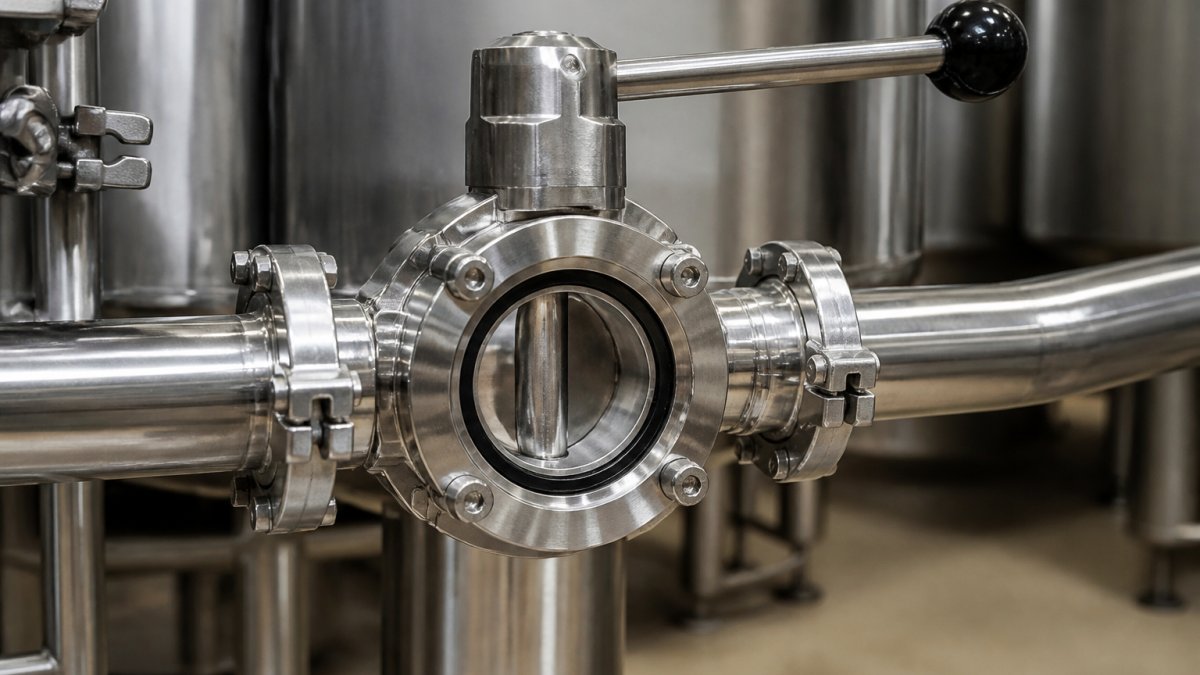
The valve body contains a rotating disc held by a stem. When the handle or actuator rotates the stem 90 degrees, the disc aligns with the flow path (fully open) or blocks it perpendicular (fully closed).
Tri-Clamp connections (also called clamp connections or sanitary clamp fittings) are the standard in beverage systems. These quick-connect fittings allow operators to remove and reinstall valve sections without breaking the entire piping system. A clamp band tightens around the valve’s flanged ends, creating a leak-free seal that withstands typical beverage line pressures of 30-100 psi.
Sanitary butterfly valve specifications typically include:
- Body material: 316L stainless steel
- Seat material: EPDM, Viton, or PTFE elastomer
- Connection type: Tri-Clamp (1.5″, 2″, 3″ common sizes)
- Pressure rating: 30-150 psi depending on model
- Temperature range: -40°F to 212°F for standard designs
- Flow capacity: Varies by disc diameter; larger discs handle higher flow rates
The disc itself is engineered for smooth flow with minimal turbulence. A polished, sanitary-grade finish on internal surfaces prevents product buildup and simplifies cleaning. Research from Dataintelo’s 2025 food and beverage valves market study confirms that stainless steel construction and hygienic design standards are now baseline expectations for beverage processing equipment.
The elastomer seal material is your critical specification choice. EPDM handles most fruit juices and water-based products but fails with alcohol above 40% ABV. Viton seals cost more but work reliably with spirits, wine, and high-proof beverages. Choosing wrong means premature seal failure and product loss.
Pneumatic Sanitary Butterfly Valve Options and Performance
Pneumatic sanitary butterfly valves use compressed air to actuate the disc, eliminating manual operation and enabling automated flow control. An air-driven actuator (piston or vane type) rotates the stem when pneumatic pressure is applied.
Performance metrics for pneumatic sanitary butterfly valves include response time, cycle life, and fail-safe positioning. A quality pneumatic actuator responds in 0.5-2 seconds, fast enough to prevent overflow or pressure spikes in carbonation lines. Cycle life typically exceeds 500,000 operations before seal degradation requires replacement, translating to 2-3 years of continuous production use.
Pneumatic systems offer two fail-safe modes. Spring-return designs close the valve if air pressure drops, protecting product from contamination during power loss. Double-acting designs hold position until air is actively reversed, giving operators precise control but requiring redundant safety measures.
Cost for a pneumatic sanitary butterfly valve runs higher than manual versions due to the actuator, solenoid valve, and air distribution hardware. However, the automation payoff justifies the investment in lines running 16+ hours daily. Valtorc International delivers pneumatic packages pre-assembled and tested.
The global sanitary actuated butterfly valve market reflects this demand: Dataintelo’s 2025 sanitary actuated butterfly valve forecast values the market at USD 449.6 million in 2025, projected to reach USD 780.3 million by 2034 at a 6.2% compound annual growth rate.
| Actuation Type | Response Time | Cycle Life | Best For | Maintenance |
|---|---|---|---|---|
| Manual handle | N/A | Unlimited | Low-volume lines, batch processing | Minimal |
| Pneumatic spring-return | 0.5-1 sec | 500K+ cycles | High-speed production, safety-critical | Air supply, seal replacement |
| Pneumatic double-acting | 1-2 sec | 500K+ cycles | Precise throttling, automated control | Air supply, solenoid maintenance |
| Electric actuator | 2-5 sec | 1M+ cycles | Integration with PLC systems | Electrical connections, rare failures |
Sanitary Valve for Beverage Processing: Applications and Selection
Sanitary butterfly valves are deployed across every major beverage category. In breweries, they control wort flow from kettle to fermentation vessel, manage yeast slurry movement, and regulate finished beer transfer to packaging. Juice producers use them to throttle concentrate, blend multiple fruit streams, and prevent backflow during pasteurization.
Dairy processors rely on these valves for milk and cream transfer, controlling flow through heat exchangers and managing product during cleaning cycles. Flavorings and condiment producers use them to blend ingredients without introducing contamination. The common thread: any beverage or food product that requires sterile handling benefits from the leak-free, easily cleanable design of a sanitary butterfly valve.
Selection depends on three primary factors: connection size, pressure rating, and elastomer compatibility. Start by determining your line’s inside diameter, 1.5″ and 2″ are standard in beverage processing, with 3″ used for high-volume lines. Confirm the maximum operating pressure; most beverage systems run 50-80 psi, but carbonation lines may spike to 150 psi. Finally, verify your product against elastomer compatibility charts.
Valtorc International’s engineering team guides this selection process. We analyze your specific line conditions and recommend the exact valve configuration needed. Custom configurations are built to order with turnaround times that are among the fastest in the industry, backed by our 40+ years of manufacturing expertise.
Undersizing a valve by one diameter creates backpressure that forces higher pump loads, reduces product throughput, and accelerates seal wear. A 1.5″ valve on a 2″ line that should handle 200 gallons per minute will choke at 120 gpm and fail seals within months. Measure your actual flow requirements, not your pipe size.
Sanitary Butterfly Valve Cleaning and Maintenance Protocols
Sanitary butterfly valves are designed for clean-in-place (CIP) and sterilize-in-place (SIP) procedures, but execution matters. CIP protocols circulate hot water, detergent, and sanitizing chemicals through the valve without disassembly. The polished internal surfaces and minimal dead legs allow cleaning solutions to reach all product-contact areas.
SIP procedures use steam at 250-270°F to sterilize the valve during standby periods. A properly designed sanitary butterfly valve withstands repeated SIP cycles without seal degradation when elastomer selection matches the steam temperature profile. EPDM seals typically tolerate SIP up to 250°F; Viton handles higher temperatures.
Maintenance intervals depend on production volume and product type. High-speed lines running acidic juices require quarterly seal inspection and replacement every 12-18 months. Lower-volume lines with neutral pH products may extend seal life to 24+ months. Manual inspection during CIP breaks, checking for visible product residue or discoloration, catches problems before they cause shutdowns.
Replacement parts are straightforward. Valtorc International stocks common repair components and ships same-day on in-stock items, minimizing downtime when replacements are needed.
Documentation of CIP and SIP procedures is mandatory in FDA-regulated facilities. Maintain records showing temperature, chemical concentration, contact time, and rinse cycles. This audit trail proves compliance during inspections and protects your product integrity claims.
Operating Limits and Performance Standards
Every sanitary butterfly valve operates within defined limits. Exceeding them degrades performance and voids manufacturer support. Understanding these boundaries prevents costly failures in production environments where downtime costs thousands per hour.
Pressure rating is the maximum sustained pressure the valve can withstand. Standard sanitary butterfly valves are rated 30-100 psi; high-pressure versions reach 150 psi.
Temperature range specifies the product temperature the valve handles safely. Standard designs operate -40°F to 212°F. Hotter products (pasteurized juice at 180°F, for example) require verification that your elastomer and body material remain stable. Colder products like frozen concentrate or chilled milk present no thermal challenge.
Flow rate depends on disc diameter and valve configuration. A 1.5″ valve typically handles 50-150 gallons per minute at rated pressure; a 2″ valve handles 100-300 gpm. Operating significantly below rated flow creates stagnation and product settling.
Cycle life for manual valves is unlimited; the handle can operate indefinitely. Pneumatic and electric actuators degrade with each cycle. Typical cycle life is 500,000-1,000,000 operations before seal wear requires replacement. In a high-speed line cycling 10 times per minute, that’s 3-6 years of service.
Performance standards in the beverage industry reference ASME BPE (Bioprocessing Equipment) and 3-A Sanitary Standards. These define surface finishes, connection geometry, and material compatibility. Compliance ensures your valve integrates seamlessly with other sanitary equipment and passes regulatory audits.
Leakage rate is specified in drops per minute at rated pressure. Zero leakage is the standard for beverage applications. If your valve weeps more than 1-2 drops per minute at operating pressure, the seal is degrading and replacement is imminent. Ignoring this signal leads to product loss and contamination risk.
Why Beverage Producers Choose Sanitary Butterfly Valves Over Alternatives
Sanitary butterfly valves eliminate dead legs and crevices where product residue accumulates. Gate valves, ball valves, and globe valves all contain internal cavities where bacteria can hide and product can spoil between cleaning cycles.
Second, they clean faster and more completely. The polished stainless steel surfaces and simple geometry mean CIP solutions reach every internal surface in minutes rather than hours. Downtime between production runs shrinks, and the risk of product carryover contamination drops.
Third, maintenance is minimal, and spare parts are inexpensive. A beverage producer managing 50+ valves across multiple lines sees substantial savings compared to more complex valve types requiring specialist maintenance.
The data supports this preference.
Beverage producers also value the standardization that comes with sanitary butterfly valves. Tri-Clamp connections are universal; any manufacturer’s valve fits any other’s piping. This interchangeability prevents vendor lock-in and lets you source replacements quickly if a primary supplier faces delays.
Sanitary butterfly valves are foundational equipment in modern beverage production. They deliver leak-free flow control, withstand aggressive cleaning protocols, and integrate seamlessly into existing systems.
At Valtorc International, we engineer sanitary butterfly valves and automated valve packages configured to your exact specifications. Our direct-from-manufacturer pricing eliminates middlemen markup, and same-day shipping on stock items means your line stays running.
Frequently Asked Questions
What is a sanitary butterfly valve?
A sanitary butterfly valve is a fluid control device with a stainless steel body and hygienic design used in food, beverage, dairy, and pharmaceutical processing. The valve contains a rotating disc (butterfly) that opens or closes to control flow through the piping system. Sanitary butterfly valves feature Tri-Clamp connections, elastomer seals, and smooth internal surfaces that prevent contamination and meet strict cleaning-in-place (CIP) and sterilize-in-place (SIP) requirements.
How does a pneumatic sanitary butterfly valve differ from a manual one?
Manual sanitary butterfly valves use a hand-operated handle for on-off control and throttling, requiring an operator at the valve location. Pneumatic sanitary butterfly valves use compressed air to actuate the disc automatically, enabling remote operation, faster response times, and integration into automated process lines. Pneumatic actuation is preferred in high-speed beverage production where consistent flow control and reduced manual intervention are critical.
What makes a sanitary butterfly valve suitable for beverage processing?
Beverage processing demands corrosion resistance, leak-free performance, and ease of cleaning. Sanitary butterfly valves meet these requirements through stainless steel construction that withstands acidic beverages and cleaning chemicals, elastomer seals that prevent contamination, and smooth internal geometry that supports CIP/SIP procedures. Tri-Clamp connections ensure compatibility with standard beverage piping systems, and the compact design fits tight spaces in brewery and production lines.
How often should a sanitary butterfly valve be maintained?
Maintenance frequency depends on production volume, fluid type, and operating temperature. Most beverage processors perform routine inspections weekly or monthly to check for leakage and verify seal integrity. Full disassembly and seal replacement typically occur annually or after 5,000-10,000 operating hours. CIP procedures should be run after each production batch to prevent yeast, wort residue, and condiment buildup. Replacement elastomer seals and stem components are readily available.

CREDIT APPLICATION
Please fill out our credit application for purchase orders and net terms. Download here

DISTRIBUTORS WANTED
Apply to become an official protected distributor. Click here to fill out our distributor application. (Online Form)

VALVE PRODUCT CATALOG
New! Download our 2018 product overview catalog or call us to request a copy. Click here to download (PDF)


