
Home »
Reliable Valve Solutions for Hygienic Compliance
Table of Contents
- What Makes a Valve Suitable for Hygienic Applications
- Stainless Steel Sanitary Valves: Material Selection for Durability
- Sanitary Valves for Pharmaceutical Processing: Compliance and Performance
- Clean-in-Place Valve Compatibility: Design and Integration
- Sanitary Valve Maintenance: Inspection Schedules and Best Practices
- Reliability and Service Life: Engineering for Long-Term Performance
- Selecting the Right Valve Solution for Your Operation
- Conclusion
- Frequently Asked Questions
Last Updated: October 8, 2026
What Makes a Valve Suitable for Hygienic Applications
A valve suitable for hygienic applications must meet strict design and material standards that prevent contamination, facilitate cleaning, and withstand sterilization cycles, the foundation of reliable valve solutions hygienic compliance. These valves serve pharmaceutical manufacturing, food processing, and beverage production, where product contact surfaces demand absolute reliability.
The core requirement is hygienic design, which eliminates dead legs, crevices, and rough surfaces where bacteria or residue can harbor. Sanitary valves feature smooth, polished internal surfaces and minimal product-contact geometry, and integrate with clean-in-place (CIP) and steam-in-place (SIP) systems so operators can clean and sterilize without disassembly.
Material selection matters enormously. Stainless steel, specifically grades like 316L, resists corrosion from cleaning agents and high-temperature steam. The valve body, seats, and stem must withstand repeated thermal cycling and aggressive sanitizers without degradation, and the design must prevent leakage that contaminates product and forces costly downtime.
Reliable valve solutions for hygienic compliance also demand traceability. Manufacturers must document that the valve meets recognized standards: FDA CFR Title 21 for food contact, USP <1231> for pharmaceutical equipment, and 3-A Sanitary Standards for dairy and beverage applications. Regulators inspect these records, and a single non-compliant valve can shut down production.
Hygienic compliance isn’t just about material, it’s about design philosophy. A valve that looks sanitary but has hidden crevices will fail inspection and contaminate product. True reliable valve solutions eliminate the places where problems hide.
Stainless Steel Sanitary Valves: Material Selection for Durability
Stainless steel is the industry standard for sanitary valve construction because it combines corrosion resistance with mechanical strength and cleanability. Grade 316L outperforms 304 in hygienic applications because its molybdenum content resists pitting corrosion from chloride-based sanitizers.
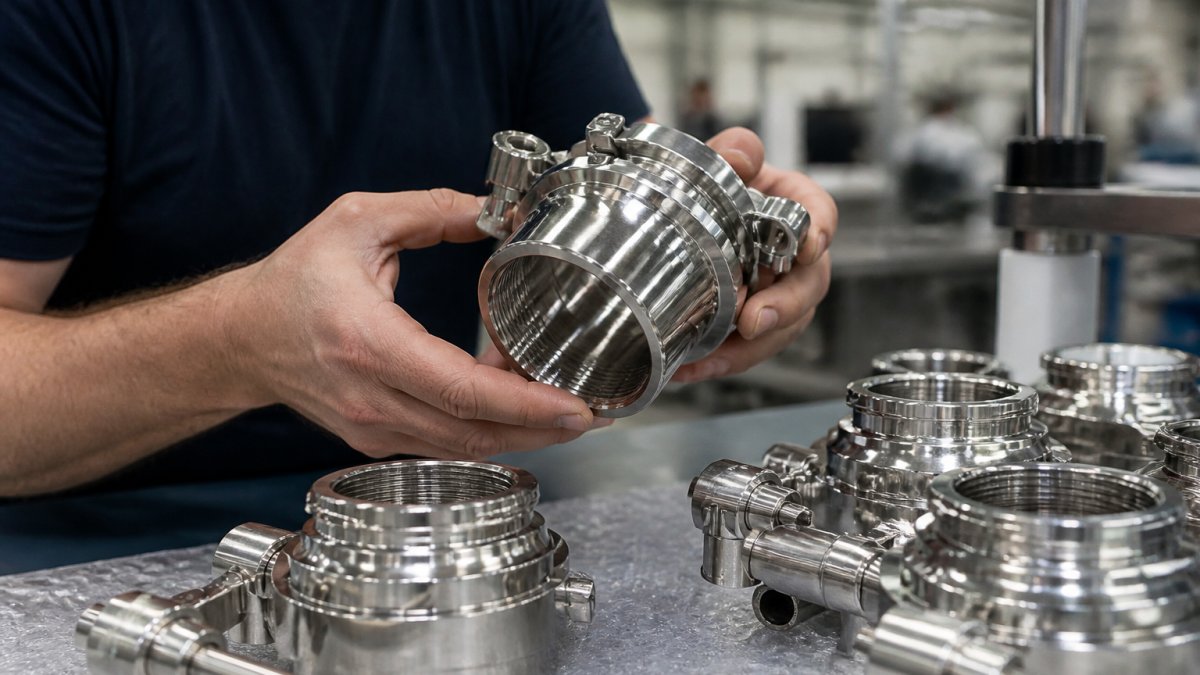
The passivation process, a chemical treatment that creates a protective oxide layer, is critical. A poorly passivated valve corrodes faster than an unfinished one. Manufacturers following ASTM A967 standards ensure the layer is uniform and stable, extending service life in high-temperature, high-pressure environments.
Surface finish also drives durability. Electropolishing creates a smooth, corrosion-resistant surface that’s easier to clean and less prone to biofilm attachment. A rough, machined surface traps bacteria and cleaning residue, leading to corrosion initiation sites. The difference between a 2-micron and 20-micron surface finish translates directly to service life and compliance risk.
Brass or bronze components, common in lower-cost valves, corrode rapidly in sanitary environments: dezincification removes zinc from brass alloys, leaving porous copper that fails mechanically. Reliable valve solutions for hygienic compliance eliminate these materials from product-contact surfaces.
A valve that “looks stainless” may be 304 instead of 316L, or poorly passivated. Corrosion doesn’t always show up immediately, it starts internally and accelerates suddenly. Always verify material certification and passivation reports before installation.
Sanitary Valves for Pharmaceutical Processing: Compliance and Performance
Pharmaceutical manufacturing demands sanitary valves that meet FDA and USP standards for product purity and equipment safety. A single valve leak contaminates an entire batch, triggering recalls, regulatory investigation, and customer notification.
FDA CFR Title 21 Part 211 requires equipment contact surfaces to prevent contamination and be cleanable without disassembly. Sanitary valves for pharmaceutical processing must be dead-leg-free, with no internal cavities where product can stagnate, and fully drainable so tilting or inverting the system empties it completely.
USP <1231> specifies that equipment must be suitable for its intended use and maintain product quality throughout the process. For valves, this means demonstrating they don’t shed particles, leach substances, or harbor microorganisms, backed by extractables and leachables data, particle counts, and microbial challenge test results.
Reliable valve solutions for pharmaceutical service also address operational efficiency. A valve that needs frequent maintenance or exhibits creep (gradual stem drift) increases downtime and labor cost, and in batch-mode plants every minute of unplanned downtime delays schedules and raises per-unit cost.
Integration with automated control systems is essential. Pharmaceutical processes require precise flow control and position feedback. Solenoid-actuated valves with limit switches and sensors provide the repeatability and traceability that batch records demand.
Clean-in-Place Valve Compatibility: Design and Integration
Clean-in-place systems spray hot cleaning solution through process equipment without disassembly, then drain and rinse. Valves must therefore open completely to allow flow, close tightly to prevent bypass, and withstand the thermal and chemical shock of rapid temperature and pressure changes.
A valve incompatible with CIP design creates dead zones where cleaning solution pools, leaving residue that hardens and contaminates the next batch.
Thermal cycling is brutal. A valve at ambient temperature suddenly exposed to 80°C cleaning solution experiences differential expansion between body, stem, and seat materials, and mismatched materials or poor design create micro-gaps that leak.
Pressure drop through the valve must be acceptable for CIP system design. Excessive restriction forces the CIP pump to work harder, raising energy cost and reducing flow velocity in downstream piping. Hygienic valve designs minimize turbulence and maintain laminar or transitional flow, improving cleaning effectiveness and cutting operating cost.
Actuated valves in CIP systems must respond reliably to solenoid signals. A valve that sticks or drifts causes CIP cycles to fail or extend unpredictably. Position feedback, limit switches or sensors indicating fully open or fully closed, ensures the CIP controller knows the valve state.
Test CIP compatibility before full-scale deployment. Run a pilot cycle with your actual cleaning chemistry at your expected flow rate and temperature. Measure pressure drop, flow rate, and temperature rise. A valve that performs well in laboratory conditions may behave differently in your real system.
::: Consistent performance during these validation trials often depends on maintaining stable facility water pressure to ensure that hydraulic fluctuations do not compromise the integrity of the cleaning process.
Sanitary Valve Maintenance: Inspection Schedules and Best Practices
Preventive maintenance extends valve service life and prevents unexpected failures. Sanitary valves in pharmaceutical and food service require scheduled inspection, testing, and occasional component replacement to maintain hygienic compliance and reliability.
A typical schedule includes quarterly external inspection for corrosion, leakage, or actuator drift. Visual inspection catches early corrosion before it penetrates the material; leakage testing, pressurizing the valve and watching for weeping, identifies seats beginning to wear; actuator testing confirms solenoid-operated valves respond within expected time windows.
Annual internal inspection involves disassembly and visual examination of the seat, stem, and bonnet surfaces.
Stem packing maintenance is critical. The packing nut, which seals the stem against leakage, loosens over time as the packing material compresses. Over-tightening causes excessive stem friction and accelerates wear; under-tightening allows leakage. Tighten it in one-quarter-turn increments until leakage stops, then back off slightly for smooth operation.
Reliable valve solutions for hygienic compliance include spare parts kits: extra seats, stems, packing, and gaskets.
Documentation is essential. Maintain logs of inspection dates, findings, and actions taken. This record demonstrates proactive equipment management to regulators and provides trending data; if a valve fails prematurely, historical inspection data helps identify whether the cause was material defect or misuse.
Reliability and Service Life: Engineering for Long-Term Performance
Service life depends on material selection, design, operating conditions, and maintenance discipline. A sanitary valve in a gentle application, low pressure, moderate temperature, non-corrosive fluid, may last 10+ years.
Design engineers specify materials and component geometries to match expected service conditions. Pressure rating, temperature rating, and chemical compatibility are the foundation: a valve rated for 150 psi at 100°F will fail at 200 psi or 150°F.
Seat and stem materials are the primary wear surfaces. Hard-facing, depositing a wear-resistant coating on the seat, extends life in abrasive or high-velocity applications. Tungsten carbide or ceramic coatings resist erosion from particulate-laden fluids. In clean pharmaceutical applications, hard-facing may not be necessary; in food processing with occasional solids, it’s often justified.
Leakage rates degrade over time as seats wear. A new valve may leak less than 1 drop per minute when closed; after 5 years, leakage may reach 5-10 drops per minute. This is normal wear, not failure, but it signals that replacement should be planned before leakage becomes unacceptable.
Thermal fatigue, repeated expansion and contraction, is a primary failure mode in CIP and SIP systems. A valve experiencing 50 CIP cycles per week at 50°C delta-T undergoes 2,600 thermal cycles per year, and fatigue cracks initiate at stress concentrations, eventually causing leakage or mechanical failure.
| Service Life Factor | Impact on Durability | Mitigation Strategy |
|---|---|---|
| Material grade (304 vs. 316L) | 316L lasts 2-3x longer in corrosive environments | Specify 316L for sanitary service |
| Passivation quality | Poor passivation reduces life by 50% | Verify ASTM A967 compliance |
| Surface finish | Rough surfaces corrode 5-10x faster | Electropolish critical surfaces |
| Operating temperature | Each 10°C increase reduces life ~15% | Select valves rated above max process temp |
| Cleaning chemistry | Chloride-based cleaners accelerate pitting | Match material to cleaning agent |
| Thermal cycling frequency | High frequency (>50/week) accelerates fatigue | Use hard-faced seats in high-cycle applications |
Selecting the Right Valve Solution for Your Operation
Valve selection begins with a clear definition of process requirements: fluid type, operating pressure, operating temperature, flow rate, and required response time. A pharmaceutical batch process has very different demands than a continuous food processing line.
Start by mapping the process. Identify each point where flow control, isolation, or check function is needed, and document fluid properties, viscosity, density, temperature, pH, and any suspended solids.
Next, identify the applicable standards. FDA food contact applications require NSF certification or equivalent. Pharmaceutical applications must meet USP <1231> and FDA CFR Title 21. Dairy applications follow 3-A Sanitary Standards.
Evaluate CIP and SIP compatibility. If the valve will be cleaned in place, verify the design allows complete drainage and the materials withstand the cleaning chemistry and temperature.
Consider maintenance access and spare parts availability.
Cost analysis should include total cost of ownership, not just purchase price, as reliable valve solutions hygienic compliance deliver lower operating cost over the asset lifetime.
Valtorc International’s approach to valve selection combines engineering expertise with direct-from-manufacturer pricing. Our team works with your process engineers to specify materials, actuation, and controls that match your exact requirements. Custom engineering eliminates over-specification, reducing cost while ensuring compliance.
Operations with strict compliance requirements (pharmaceutical, food, beverage) and high-volume production where downtime cost is significant. If your facility runs continuous processes or frequent batch cycles, the reliability premium pays for itself within months.
Conclusion
Hygienic compliance and long service life depend on material selection, design philosophy, and maintenance discipline. Stainless steel sanitary valves engineered to eliminate dead legs and facilitate cleaning are the foundation. Integration with CIP and SIP systems, combined with predictive maintenance schedules, extends service life and prevents contamination events.
Valtorc International manufactures reliable valve solutions for hygienic compliance across pharmaceutical, food, and beverage applications. Our 40+ years of industry expertise and custom engineering ensure your valves meet exact specifications, eliminating over-cost while guaranteeing performance. Request a quote today and discover how direct-from-manufacturer pricing and same-day shipping accelerate your project timeline while reducing total cost of ownership.
FDA CFR Title 21 Part 211 requirements for pharmaceutical equipment design
USP <1231> standards for equipment suitability in pharmaceutical manufacturing
ASTM A967 standard for passivation of stainless steel
Frequently Asked Questions
What makes a valve suitable for hygienic applications?
A hygienic valve must have a smooth, polished surface finish that prevents bacterial growth and product residue accumulation. It requires crevice-free design, sanitary connections, and materials resistant to corrosion from cleaning agents and sterilization processes. The valve must support clean-in-place and steam-in-place procedures without degradation, and meet FDA, USDA, or 3-A Sanitary Standards requirements depending on your industry. Proper seal design and accessible maintenance points are equally critical for compliance.
Which valve materials are best for pharmaceutical processing?
Stainless steel sanitary valves, particularly 316L or higher grades, are the industry standard for pharmaceutical applications. These materials resist corrosion from cleaning solutions, steam sterilization, and product contact. Brass components should be avoided in direct product contact. The material selection depends on your specific process conditions, temperature ranges, and chemical exposure. Always verify material certifications and traceability documentation from your supplier to meet FDA and USP requirements.
How often should sanitary valves be inspected or maintained?
Inspection frequency depends on operating conditions, process criticality, and manufacturer recommendations. Most pharmaceutical and food processing operations conduct visual inspections monthly, with detailed maintenance quarterly or semi-annually. High-temperature or high-pressure applications may require more frequent checks. Maintain detailed logs of all inspections, seal replacements, and performance data. Work with your valve supplier to establish a preventive maintenance schedule that aligns with your facility’s validation requirements and operational demands.
What documentation should suppliers provide for hygienic valves?
Reputable suppliers must provide material certifications (mill certs), design specifications, pressure-temperature ratings, and validation documentation. For pharmaceutical applications, request FDA compliance statements, 3-A Sanitary Standards certifications, and traceability records. Ensure suppliers deliver installation drawings, maintenance manuals, and spare parts availability information. Ask for case studies or references from similar operations.

CREDIT APPLICATION
Please fill out our credit application for purchase orders and net terms. Download here

DISTRIBUTORS WANTED
Apply to become an official protected distributor. Click here to fill out our distributor application. (Online Form)

VALVE PRODUCT CATALOG
New! Download our 2018 product overview catalog or call us to request a copy. Click here to download (PDF)


