
Home »
FDA Compliant Sanitary Valve Requirements 2026
Table of Contents
- Understanding FDA Compliant Sanitary Valve Requirements
- 3-A Sanitary Standards for Valves vs. FDA Regulations
- Sanitary Plug Valve Material Requirements and Specifications
- Hygienic Design Principles and Dead Leg Reduction
- CIP and SIP Compatibility for Sanitary Valve Systems
- Sanitary Valve Maintenance Best Practices and 2026 Compliance
- Impact of 2026 FDA Food Code Updates on Sanitary Valve Hardware
- Troubleshooting Non-Compliant Installations
- Frequently Asked Questions
Last Updated: October 4, 2026
Understanding FDA Compliant Sanitary Valve Requirements
FDA compliant sanitary valve requirements 2026 define the technical and regulatory standards that valve manufacturers and food and beverage processors must meet to ensure product safety and regulatory compliance. The FDA doesn’t directly regulate individual valve components; instead, the FDA Food Code 2026 establishes food safety guidelines that determine what valve specifications your facility requires.
The food and beverage valves market was valued at $6.8 billion in 2025 and is projected to reach $11.4 billion by 2034, driven by stricter compliance requirements and increased automation.
The biggest mistake we see is treating FDA compliance and 3-A standards as interchangeable. They’re not. FDA compliance is regulatory; 3-A standards are design specifications. You need both.
3-A Sanitary Standards for Valves vs. FDA Regulations
The FDA regulates finished food products and processes but not valve components. Instead, the industry relies on 3-A Sanitary Standards, voluntary specifications developed collaboratively by the FDA, equipment manufacturers, and food processing associations.
How 3-A Standards Differ from FDA Food Code
3-A standards focus on equipment design and material specifications that prevent contamination and allow effective cleaning. The FDA Food Code 2026 establishes operational and procedural requirements that food processors must follow. 3-A tells you what the valve must be made of and how it must be designed; the FDA Food Code tells you how you must use and maintain it.
For valve selection, the critical requirement is that equipment must prevent product contamination and support effective cleaning-in-place (CIP) and sterilization-in-place (SIP) operations.
Material Certification and Compliance Documentation
Material traceability and certification are non-negotiable. Every stainless steel component, gasket, and seal must come with documentation proving it meets food-contact substance standards.
When sourcing sanitary valves, require your supplier to provide material certs for all product contact surfaces (typically 316L stainless steel), elastomer compatibility documentation, third-party testing reports, and full traceability records.
Sanitary Plug Valve Material Requirements and Specifications
The material you choose for your sanitary valve directly determines whether your facility passes inspection or faces corrective action.
Stainless Steel Grades and Surface Finish Standards
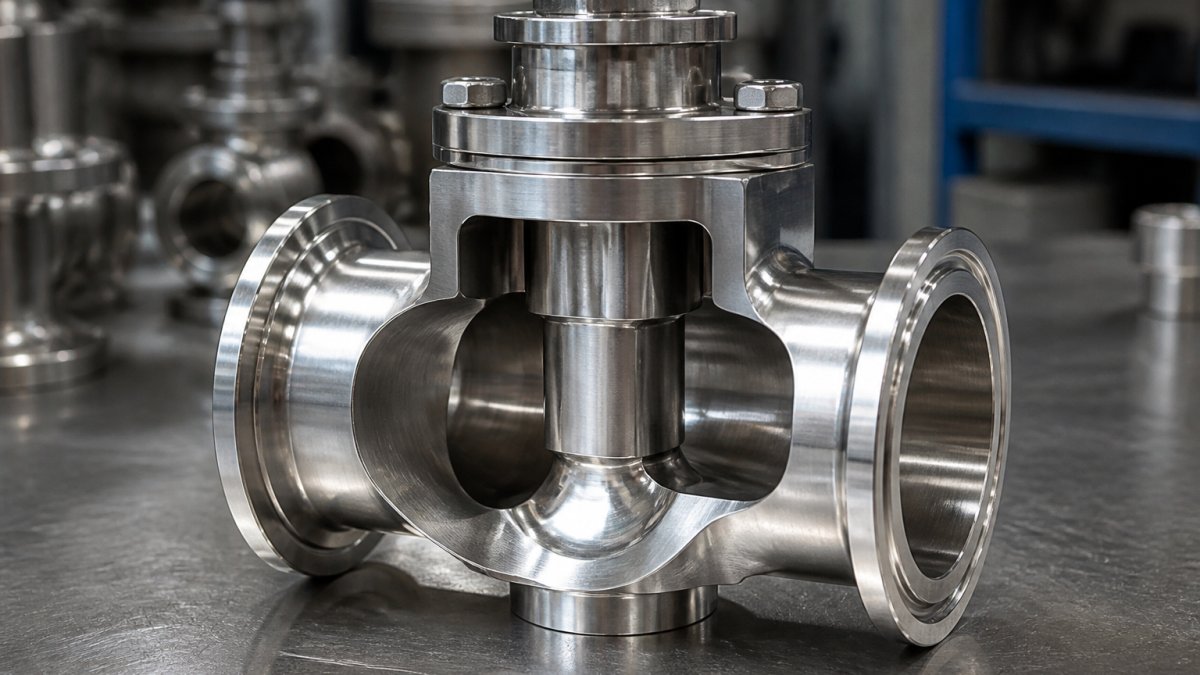
Stainless steel 316L is the industry standard for all product-contact surfaces. The surface finish requirement is Ra ≤ 0.8μm (32 microinches), which prevents bacterial harborage in microscopic irregularities.
Demand surface finish testing reports from your supplier; valves exceeding this roughness can trap pathogens.
Elastomer Compatibility and Gasket Integrity
Gaskets and seals are as critical as the valve body. EPDM works well with water-based solutions and mild acids; FKM handles stronger solvents and higher temperatures.
Request compatibility matrices from your valve supplier for your specific cleaning chemicals and temperatures. Seal degradation is a leading cause of non-compliance findings.
Gasket failure is silent and invisible until it causes a contamination event. Inspect gaskets during every maintenance cycle and replace them proactively every 12-18 months in high-use applications.
Hygienic Design Principles and Dead Leg Reduction
Dead legs, sections where product stagnates and bacteria grow, must not exceed 1.5 times the pipe diameter per 3-A standards.
A well-engineered sanitary valve has full-port design, minimal cavity volume, sloped internal surfaces to prevent pooling, and proper connection geometry to eliminate dead legs.
CIP and SIP Compatibility for Sanitary Valve Systems
Your valve must survive and enable both CIP (automated circulation of hot water, detergent, and sanitizer) and SIP (steam exposure at 121-135°C) cycles.
Your valve must withstand 500+ CIP cycles and 100+ SIP cycles without leakage or degradation; demand test reports.
| Requirement | CIP Compatibility | SIP Compatibility |
|---|---|---|
| Temperature range | 50-80°C | 121-135°C |
| Exposure cycles | 500+ | 100+ |
| Elastomer stability | Alkaline-resistant | Heat-resistant |
| Material stress | Minimal | Critical |
| Documentation | Cleaning protocol | Validation report |
Sanitary Valve Maintenance Best Practices and 2026 Compliance
Compliance doesn’t end at installation. Your maintenance practices determine whether your valve stays compliant or becomes a liability.
Quarterly Compliance Audit Checklist for Sanitary Valves
Establish a documented inspection schedule: quarterly deep inspections combined with monthly visual checks catch degradation early.
Monthly Visual Inspection (15 minutes per valve)
- Exterior corrosion or discoloration: Document any rust, white deposits, or color change.
- Gasket weeping or visible leakage: Measure leak rate and note when it occurs.
- Actuator or handle condition: Verify smooth operation; binding indicates corrosion or seal friction.
Quarterly Functional Testing (45 minutes per valve)
- Pressure decay test: Pressurize to 50% of rated pressure and monitor for 10 minutes. <2 psi drop is acceptable; >5 psi drop requires immediate replacement.
- Dead leg flushing verification: During CIP, check downstream fluid clarity; cloudiness indicates inadequate flushing.
- Gasket visual assessment: Inspect under 10x magnification for hardening, swelling, cracking, or deformation; replace if present.
Annual Deep Inspection and Validation (2-3 hours per valve)
- Internal passage inspection: Disassemble and inspect for pitting, crevice corrosion, or deposits; pitting >0.5 mm requires replacement.
- Elastomer compatibility re-verification: If cleaning chemicals, sanitizers, or temperatures have changed, re-verify compatibility.
- CIP/SIP cycle count validation: Track cumulative cycles; plan replacement before exceeding 500 CIP or 100 SIP cycles.
Documentation and Traceability Records
Every inspection, repair, and replacement must be documented with date, findings, and corrective actions.
Maintain a valve asset register including valve identification, material documentation, operational parameters, maintenance history, regulatory events, and supplier contact information.
If a regulatory inspector asks for maintenance records and you cannot produce them, the valve is presumed non-compliant regardless of its actual condition. Implement documentation immediately.
Common Maintenance Failure Modes and How to Prevent Them
Gasket degradation: Obtain elastomer compatibility matrices for every cleaning chemical. Upgrade to FKM gaskets if EPDM is failing.
Corrosion pitting: Rinse valves thoroughly after CIP cycles.
Dead leg accumulation: Verify piping geometry during installation. During quarterly inspections, flush dead legs aggressively and monitor fluid clarity.
Seal degradation from thermal cycling: Repeated heating and cooling causes elastomers to lose elasticity over time.
The most expensive maintenance is emergency replacement after a contamination event or audit failure. The cheapest maintenance is preventive inspection and planned component replacement on a schedule. A quarterly audit checklist and annual deep inspection will catch 95% of problems before they become compliance issues.
Impact of 2026 FDA Food Code Updates on Sanitary Valve Hardware
The 2026 FDA Food Code introduced changes that directly affect valve specification, installation, and operation. If your facility hasn’t updated its equipment specifications since 2024, you’re likely operating under outdated assumptions about what compliance means.
Key 2026 Food Code Changes Affecting Valve Selection
Equipment Design and Maintenance (Section 4-204.112)
The Code now explicitly requires that all equipment used in food processing “shall be designed, constructed, and installed to be easily cleanable and shall be maintained in good repair.” “Easily cleanable” now means:
- The valve must support CIP and SIP without degradation
- Dead legs must be eliminated or minimized (≤1.5x pipe diameter)
- Surface finish must be documented and verified (Ra ≤0.8 μm)
A valve that meets 3-A standards automatically meets this requirement.
Food Defense and Traceability (Section 3-501.1 and Appendix A)
The 2026 Code expanded food defense requirements to include equipment traceability. This means:
- Every valve component must be traceable to its source
- Material certs must be maintained for the life of the equipment
- Any modification or repair to a valve must be documented
If your current valve supplier cannot provide these documents, you need a new supplier.
Preventive Controls and Equipment Validation (Section 3-502.11)
The Code now requires food facilities to establish and maintain preventive controls, including equipment validation. For valves, this means:
- You must validate that your valve design prevents product contamination
- You must document CIP and SIP effectiveness for each valve
- You must establish a maintenance schedule and follow it
Practical Hardware Implications for 2026 Compliance
Stainless Steel Grade Specification
316L stainless steel is the minimum acceptable grade for food contact surfaces.
When specifying a valve, explicitly state “316L stainless steel for all product-contact surfaces” and require mill certs confirming the grade.
Gasket and Seal Material Compatibility
You must document elastomer compatibility with your specific cleaning and sanitizing chemicals.
Common gasket materials:
- EPDM: Compatible with water, mild acids, and alkaline cleaners up to pH 12. Not suitable for strong solvents or temperatures above 80°C.
- FKM (Viton): Compatible with aggressive alkaline cleaners, solvents, and temperatures up to 120°C. Cost: 20-30% premium over EPDM.
- PTFE (Teflon): Chemically inert and suitable for any cleaning chemical. Cost: 50-100% premium over EPDM.
Dead Leg Elimination and Hygienic Design
Valves must be full-port design with dead leg elimination.
Documentation Requirements for 2026 Compliance
At Installation
- Valve model, serial number, and manufacturer
- Material certs for the valve body and all elastomers
- Surface finish testing reports
During Operation
- Maintenance schedule and inspection records
- CIP and SIP cycle counts
- Any repairs or parts replacements
For Regulatory Inspection
- All of the above, organized and readily available
- Evidence that you follow your maintenance schedule
- Records of any corrective actions taken
The 2026 Food Code shift toward equipment validation and preventive controls means your valve supplier is now part of your compliance program. Choose suppliers who understand 2026 requirements and can provide complete documentation packages.
Troubleshooting Non-Compliant Installations
Non-compliance findings during regulatory audits typically fall into a few categories.
Surface finish exceeds Ra 0.8μm: The valve body has corrosion, pitting, or rough machining marks.
Gasket material incompatible with cleaning chemicals: The elastomer is swelling or degrading.
Inadequate maintenance documentation: You have the right valve, but no records to prove it’s being maintained.
The most expensive fix is replacing a valve after an audit failure.
Frequently Asked Questions
What is the difference between FDA compliance and 3-A Sanitary Standards for valves?
FDA compliance ensures sanitary valves meet food safety regulations under the FDA Food Code and FSMA requirements, focusing on preventing contamination in food processing. 3-A Sanitary Standards are voluntary industry standards that define hygienic design principles, material specifications, and surface finish requirements (Ra ≤ 0.8μm). Many manufacturers meet both standards simultaneously. 3-A standards are often more stringent than baseline FDA requirements, making them the preferred benchmark for food and beverage facilities.
What materials are approved for FDA-compliant sanitary valves?
FDA-compliant sanitary valves typically use 316L stainless steel for product-contact surfaces due to its corrosion resistance and food-grade certification. Gaskets and seals must use elastomers compatible with cleaning and sterilization processes, such as EPDM or FKM. All materials must have documented material traceability records and third-party certifications. Surface finishes must meet Ra ≤ 0.8μm (32 microinches) to prevent bacterial harborage. Valve manufacturers must provide material test reports (MTRs) and certificates of conformance for regulatory audits.
How does the 2026 FDA Food Code impact sanitary valve selection?
The 2026 FDA Food Code emphasizes food defense, employee illness prevention, and food safety management systems. This affects sanitary valve selection by requiring enhanced traceability, validation protocols for cleaning processes, and documentation of process equipment specifications. Facilities must now verify that all product-contact surfaces, including valve body geometry, meet hygienic design standards. The extended FSMA traceability compliance deadline (July 20, 2028) requires facilities to maintain detailed records of valve specifications and maintenance, influencing procurement and documentation practices.
What is the required surface finish for FDA-compliant sanitary valves?
The industry standard for FDA-compliant sanitary valves is Ra ≤ 0.8μm (32 microinches), which prevents microbial harborage and bacterial growth on product-contact surfaces. This specification aligns with 3-A Sanitary Standards and FDA hygienic design requirements. Manufacturers must document surface roughness measurements using profilometry testing. A polished finish at this specification reduces contaminant mitigation risk and improves cleanability during CIP (Cleaning-in-Place) processes. Valves failing to meet this standard cannot be certified as FDA-compliant.
What maintenance schedule ensures sanitary valve compliance in 2026?
FDA-compliant sanitary valves require documented inspection every 6-12 months, depending on process frequency and product type. Inspections should verify gasket integrity, check for corrosion or seal degradation, and confirm proper valve operation. All maintenance activities must be recorded with dates, findings, and corrective actions. Facilities should conduct validation protocols annually to confirm CIP/SIP effectiveness. Documentation must be retained for regulatory audits, particularly with the 2026 Food Code emphasis on traceability records and process safety validation.
How do CIP and SIP processes affect sanitary valve design?
Sanitary valves must be fully compatible with Cleaning-in-Place (CIP) and Sterilization-in-Place (SIP) processes. This means valve body geometry must allow complete drainage (dead leg reduction), elastomer seals must withstand high-temperature steam or chemical sanitizers, and all crevices must be accessible for cleaning. Valves designed to 3-A standards include drains and vent ports to eliminate dead legs where bacteria can survive. SIP compatibility requires seals rated for 250°F to 300°F and stainless steel construction that resists corrosion from caustic cleaning agents.
What documentation is required for FDA regulatory audits of sanitary valve installations?
FDA regulatory audits require material traceability records (MTRs), certificates of conformance, surface finish test reports (Ra measurements), and validation protocols for cleaning processes. Facilities must document valve specifications, installation dates, and maintenance history. With the FSMA traceability extension to July 20, 2028, detailed records of product-contact surfaces and process equipment modifications are critical. Valve manufacturers should provide third-party certifications confirming 3-A Sanitary Standards compliance and FDA Food Code alignment. Missing documentation can result in non-compliance citations.
Regulatory compliance requires more than buying a valve labeled “sanitary.” It requires understanding FDA expectations, 3-A standards, material specifications, and maintenance protocols, and then executing consistently. Valtorc International has engineered sanitary valve solutions that meet 2026 compliance requirements and provides the documentation and support to help you maintain that compliance long-term. Request a quote and let us help you specify the right valve for your facility.

CREDIT APPLICATION
Please fill out our credit application for purchase orders and net terms. Download here

DISTRIBUTORS WANTED
Apply to become an official protected distributor. Click here to fill out our distributor application. (Online Form)

VALVE PRODUCT CATALOG
New! Download our 2018 product overview catalog or call us to request a copy. Click here to download (PDF)


