
Home »
Custom Automated Valve Package Turnaround Times
Table of Contents
- What Determines Custom Automated Valve Package Turnaround Times
- Industrial Valve Lead Times: From Order to Shipment
- Custom Valve Package Specifications and Their Impact on Delivery
- Valve Actuator Availability and Supply-Chain Risk
- Valve Package Testing and Documentation Requirements
- Reducing Turnaround Time: A Practical Checklist for Procurement
- Expediting Options and Real-World Timeline Scenarios
- Frequently Asked Questions
Last Updated: October 6, 2026
What Determines Custom Automated Valve Package Turnaround Times
A custom automated valve package turnaround time depends on component availability, specification clarity, assembly complexity, and testing requirements. Understanding these drivers helps you plan procurement accurately.
At Valtorc International, we’ve tracked these variables across thousands of orders. A simple package with standard components might ship in days; a fully custom solution with integrated instrumentation and specialized testing can stretch into weeks.
The key insight most buyers miss: the longest delays happen before manufacturing starts. Order processing, specification validation, and component sourcing consume more calendar time than assembly and testing combined.
Custom automated valve package turnaround times typically range from one to two weeks for standard configurations, but complexity, component availability, and specification clarity can extend timelines significantly.
Industrial Valve Lead Times: From Order to Shipment
Industrial valve lead times break down into distinct stages, but the mistake most buyers make is adding them end-to-end. Some stages overlap and some are gated by customer approvals, so a realistic timeline must account for both.
The stages, and which ones run in parallel
- Order processing and PO acknowledgment: 1-2 business days. Clock starts at PO receipt, not quote.
- Specification review and submittal approval: 2-5 business days for the supplier to produce a submittal, plus however long your engineering team takes to approve it. This is the most common hidden delay, the supplier’s clock stops while the submittal sits in your inbox.
- Component sourcing and procurement: 3-10 business days when actuators and accessories are stocked; 2-4 weeks when they are not. This can run in parallel with submittal approval if long-lead components are released early.
- Custom assembly and configuration: 3-7 business days, and it cannot begin until the submittal is approved and components are on hand.
- Testing, inspection, and documentation: 2-5 business days for in-house pressure, function, and cycle testing; add 3-5 business days for third-party inspection or certification.
- Final QA, packing, and shipment readiness: 1-2 business days.
Three realistic scenarios, with assumptions stated
These ranges assume a domestic supplier with stocked valve bodies and normal freight. They are illustrative, not quotes.
Standard package (stock valve body, stocked pneumatic actuator, no third-party inspection): roughly 8-14 business days order-to-ship, with a simple submittal and in-house testing.
Moderately customized package (special trim or coating, electric actuator with a non-stock torque rating, basic documentation): roughly 15-25 business days.
Highly engineered package (custom control panel, hazardous-area certification, SCADA integration, witnessed factory acceptance test): roughly 30-50 business days.
A useful rule of thumb: the more of the package that is stocked rather than built, and the faster your team returns the approved submittal, the closer you land to the low end of each range. The high end is almost always driven by a non-stock component or a waiting-on-approval gap, not by assembly labor.
Where the calendar time actually goes
Across typical orders, the longest single block is component sourcing, followed by submittal approval. Assembly and testing, the stages buyers worry about most, are usually the shortest. Asking for a lead time without also asking “what is the longest-lead component, and when does the submittal clock start?” tends to produce an optimistic number that slips.
UMC Energy reports turnaround in hours to less than a week for automated valve systems when actuator inventory is available. That is achievable only when the specification matches stock exactly and no submittal revision is required.
Ask your supplier to quote lead time two ways: (1) from PO receipt assuming the submittal is approved within 48 hours, and (2) from submittal approval. The difference tells you how much of the schedule you control.
Custom Valve Package Specifications and Their Impact on Delivery
Specification clarity directly controls turnaround time: a well-defined spec moves fast, while an ambiguous one delays every stage.
When you request a custom automated valve package, the supplier needs complete information:
- Valve type, size, and pressure rating
- Flow rate and fluid compatibility requirements
- Actuator type (pneumatic, electric, hydraulic) and response time
- Control signal integration (analog, digital, fieldbus protocol)
- Testing and certification requirements
- Environmental conditions (temperature, corrosion exposure, sanitary vs. industrial)
- Documentation and compliance needs
Each missing detail triggers a clarification cycle: the supplier emails questions, you gather answers from engineering, and that exchange takes 2-3 days minimum. Three or four rounds add a full week before manufacturing begins.
How Underspecified or Incompatible Components Extend Lead Times
Underspecified packages are a common source of delays.
Incompatible component combinations create bigger problems.
The fix: provide a detailed specification covering not just what you need but how all components work together, valve sizing, actuator duty cycle requirements, and control system architecture.
Ferguson Industrial’s case studies show that configuration guidance for automated ball-valve packages takes less than 15 minutes when specifications are complete. The time savings come from eliminating back-and-forth clarification.
Valve Actuator Availability and Supply-Chain Risk
Actuators are the single biggest supply-chain risk in custom automated valve packages. Valve bodies and trim are relatively standard; actuators are specialized, often custom-configured, and subject to longer lead times.
Pneumatic actuators are generally available quickly, most suppliers stock common sizes. Electric actuators have longer lead times, especially if you need custom torque ratings or integrated electronics.
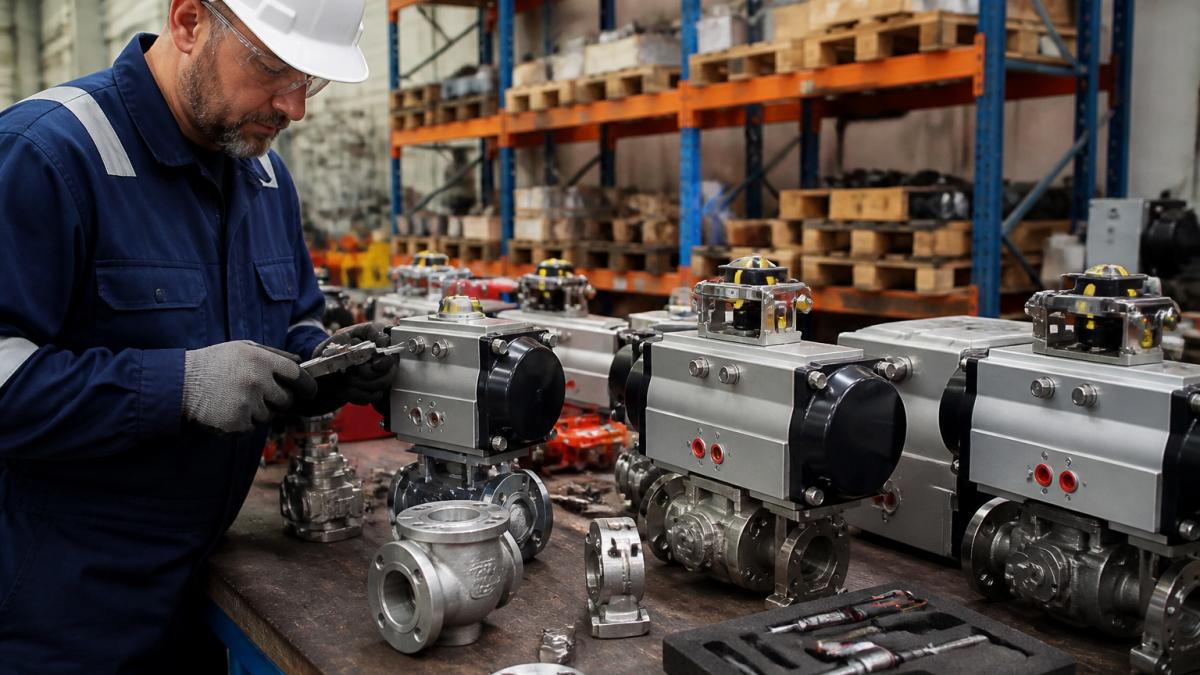
Relying on a supplier who sources actuators externally adds 1-2 weeks of risk to your timeline. If the actuator supplier has a delay, your entire project stalls.
Valve Package Testing and Documentation Requirements
Testing and documentation are often overlooked in lead-time estimates but consume 2-5 business days of your total cycle.
A complete automated valve package requires:
- Pressure testing: Ensures the valve body and seals hold rated pressure without leakage
- Actuator function testing: Confirms the actuator responds correctly to control signals
- Cycle testing: Validates the package operates smoothly through multiple open-close cycles
- Instrumentation verification: Confirms sensors, transmitters, and feedback signals work as specified
- Documentation package: Includes test reports, certification, as-built drawings, and maintenance manuals
Industrial applications, oil and gas, chemical processing, food and beverage, often require third-party inspection or certification.
Testing also catches design flaws. If a component is incompatible or undersized, you either accept a workaround (delaying shipment) or redesign and retest (adding 5-7 days).
Specify testing and documentation requirements upfront. If you don’t need third-party certification, say so; if you do, confirm the supplier has access to the certifying body and has done it before.
Reducing Turnaround Time: A Practical Checklist for Procurement
You can compress custom automated valve package turnaround times by 3-7 days with better planning. Use this checklist before submitting your request:
- Complete valve specification: Valve type, size, pressure rating, flow rate, fluid compatibility
- Actuator details: Type (pneumatic/electric/hydraulic), torque or flow requirements, response time needs
- Control system integration: Signal type (analog, digital, fieldbus), voltage, protocol requirements
- Environmental conditions: Operating temperature range, corrosion exposure, sanitary or industrial duty
- Testing and certification requirements: Pressure test, cycle test, third-party inspection, compliance standards
- Documentation needs: As-built drawings, test reports, maintenance manuals, compliance certificates
- Delivery timeline: Your actual deadline, not a guess
- Component availability: Ask the supplier what they stock and what requires sourcing
- Interface details: How the package connects to your existing system, any custom mounting or plumbing
- Spare parts strategy: Do you need quick-turn spares available after delivery?
Submitting a complete package typically compresses the order-to-shipment cycle by 25-30%, eliminating clarification cycles, accelerating component sourcing, and reducing rework risk.
Valtorc International provides guidance on custom automated valve package specifications and lead times through direct consultation. Contacting the team with your complete specification upfront sets the stage for faster turnaround.
Expediting Options and Real-World Timeline Scenarios
Expediting a custom automated valve package is not a single lever but a set of trade-offs, each moving a different part of the schedule while accepting a different risk. Knowing which lever to pull, and what it costs technically, separates a realistic expedite from a premium-priced standard order.
The expediting levers and what each one actually buys you
Partial shipments. Shipping the valve and actuator first and control accessories later lets installation begin sooner, pulling field work forward by a week or more.
Expedited freight. Once built and tested, air or dedicated truck freight cuts transit from several days to one or two.
Priority assembly. Moving your order to the front of the assembly queue saves 2-4 business days.
Reduced testing scope. Skipping extended cycle testing and running only pressure and function tests saves 1-3 business days.
“Rush” pricing is often applied to orders that are not actually being expedited, they are simply standard timelines sold at a premium. Before paying for rush service, ask the supplier to name the specific lever they are pulling and the number of business days it saves. If they cannot, you are paying for a label, not a schedule.
Real-world scenarios
Scenario 1: Planned retrofit with a comfortable window. Five custom automated ball-valve packages for a process upgrade, eight-week project timeline, complete specification submitted upfront.
Scenario 2: Emergency replacement after a failure. A valve fails mid-week and a replacement is needed by week’s end.
Scenario 3: New-build with a long-lead control system. A new water treatment facility requires a custom integrated control system with SCADA connectivity. The control electronics carry a four-week lead time from the manufacturer.
Managing the schedule after the PO is placed
Most avoidable delays happen after the order is placed. A simple discipline prevents them:
- Track the submittal. Confirm receipt, set an internal deadline to return it approved, and treat that deadline as a project milestone.
- Control changes. Every post-PO change, a different actuator, an added accessory, a revised tag number, resets part of the schedule. Route changes through one point of contact and get the schedule impact in writing before approving.
- Request progress updates at fixed intervals. Weekly is standard for custom packages; more often for expedited orders. Ask specifically about the longest-lead component, not general status.
- Schedule the factory acceptance test early. If a witnessed FAT is required, book it as soon as the submittal is approved. Calendar conflicts, not build time, usually cause FAT-driven slips.
- Confirm shipment readiness in writing. Documentation, test reports, and packing lists should be verified before the freight is booked, not after.
The common thread: successful procurement aligns timeline expectations with supply-chain reality. Expediting works when inventory exists; custom lead times are unavoidable when components must be sourced or manufactured. Buyers who hit their dates plan for both.
Frequently Asked Questions
How long does it take to build a custom automated valve package?
Custom automated valve package turnaround times vary widely depending on scope and complexity. Standard lead times typically range from one to three weeks after order placement. Some suppliers report faster delivery when actuator inventory is available, potentially shipping within days. The timeline includes order processing, custom assembly, testing, inspection, and quality assurance. Request-to-prototype timelines can be as short as two weeks for certain configurations, but full package delivery depends on component availability and your specific specifications.
What factors affect automated valve package lead times the most?
Three primary factors drive turnaround time: valve and actuator availability, custom assembly and configuration complexity, and testing and documentation requirements. Supply-chain delays in obtaining control valves or actuators are the most common cause of extended lead times. Package complexity, such as CIP/SIP compatibility, high-temperature or high-pressure requirements, or FDA compliance, increases production time. Order accuracy also matters; underspecified or incompatible components require rework and delay shipment. Batch turnaround and cleaning cycles add additional days for sanitary applications.
How can I reduce turnaround time when ordering a custom valve package?
Provide complete and accurate specifications upfront, including valve type, actuator requirements, system compatibility details, and any regulatory requirements (FDA, MOCA compliance). Confirm component availability with your supplier before finalizing the order. Request expediting options if you have a tight delivery schedule; some manufacturers offer faster assembly when inventory is stocked. Work with suppliers who maintain robust actuator inventory and use efficient order-to-shipment processes. Early communication about your timeline and requirements prevents delays caused by specification revisions or component sourcing.
What information should I provide to get an accurate delivery estimate?
Supply your supplier with detailed custom valve package specifications: valve type and size, actuator model and response time, inlet and outlet configurations, pressure and temperature ratings, and any special requirements (sanitary design, explosion-proof, specific certifications). Include your desired delivery date and any expediting constraints. Specify testing and inspection requirements, documentation needs, and maintenance or servicing expectations. Mention any supply-chain or inventory concerns on your end. The more complete your request, the faster your supplier can quote an accurate lead time and identify potential delays before they occur.

CREDIT APPLICATION
Please fill out our credit application for purchase orders and net terms. Download here

DISTRIBUTORS WANTED
Apply to become an official protected distributor. Click here to fill out our distributor application. (Online Form)

VALVE PRODUCT CATALOG
New! Download our 2018 product overview catalog or call us to request a copy. Click here to download (PDF)


